02 · Research
Research & projects
Competitive funding, observational infrastructures and open tools.
My research trajectory is sustained by continuous competitive funding as Principal Investigator (PI) and as team member, and is articulated around three long-term observational infrastructures — the Gibraltar Fixed Time Series (GIFT), the Balearic Ocean Acidification Time Series (BOATS) and the Antarctic COJOHNS time series (Johnsons Cove, Livingston Island) — and the OCEAN–IA framework that applies artificial intelligence to environmental impact assessment in marine systems.
- Projects as PI
- 6
- Captured as PI
- €359k
- Team Projects
- 27
- International
- 8
01 /
Current position
MOMENTUM — Postdoctoral Excellence Programme
Postdoctoral Researcher
Research framed within the OCEAN–IA line: development of deep-learning methodologies for reconstructing and predicting ocean acidification, deoxygenation and greenhouse-gas fluxes in coastal and deep-sea environments, integrating high-frequency oceanographic observations, satellite products and geophysical information.
Main objectives
- Deep-learning models (BiLSTM) for continuous pH, pCO₂ and GHG time series
- Integration of oceanographic, meteorological and seismic data
- Extension of the OCEAN–IA framework to polar systems (Deception Island, Antarctica)
- Assessment of ocean acidification trends in the Western Mediterranean
02 /
Projects as Principal Investigator
Total competitive funding captured as PI
€ 359,410.10
GHG-Andalusia
GHG Monitoring across Andalusian Ecosystems
Multiplatform monitoring of greenhouse-gas emissions across coastal, continental and marine systems of Andalusia, combining fixed stations, autonomous sensors and ship-based observations.
- Funding
- ICMAN-CSIC — Grants for Technical & R&D Management Support
- Budget
- € 80,000
INDICLIMA
Jul 2024 – Jul 2027
Key Indicators for Climate-Change Impacts in Deep-Sea Ecosystems
Development of biogeochemical indicators for evaluating climate-change impacts on deep-sea ecosystems of the Western Mediterranean, building on the methodological outputs of EVALUARTE.
- Funding
- EU NextGeneration — BIOACT 2024 (BIOACT2024-004)
- Budget
- € 67,850.10
EVALUARTE
Jun 2022 – Jun 2025
Vulnerability of Deep-Sea Ecosystems to Climate Change
Integrated assessment of the vulnerability of deep-sea ecosystems to climate change in the Western Mediterranean, examining the state of the art and trends in the Balearic Sea Basin.
- Funding
- Gobierno de las Islas Baleares — Vicenç Mut 2022
- Budget
- € 114,000
STARTER
Mar 2021 – Mar 2022
Impact of Wastewater Outfalls on Posidonia oceanica
Quantification of the impact of wastewater discharges on the ecosystem services provided by Posidonia oceanica meadows in Mallorca.
- Funding
- Cátedra de la Mar — Fundación Iberostar
- Budget
- € 12,000
Margalida Comas 2017
Dec 2017 – Dec 2019
pH Variability in Coastal Areas
Comparison across scales and sources of pH variability in Mediterranean coastal areas, establishing baselines for ocean acidification monitoring. Machine-learning applications for pH reconstruction, published in Scientific Reports.
- Funding
- Gobierno de las Islas Baleares
- Budget
- € 66,000
AAEE111/2017
Jun 2018 – Jul 2019
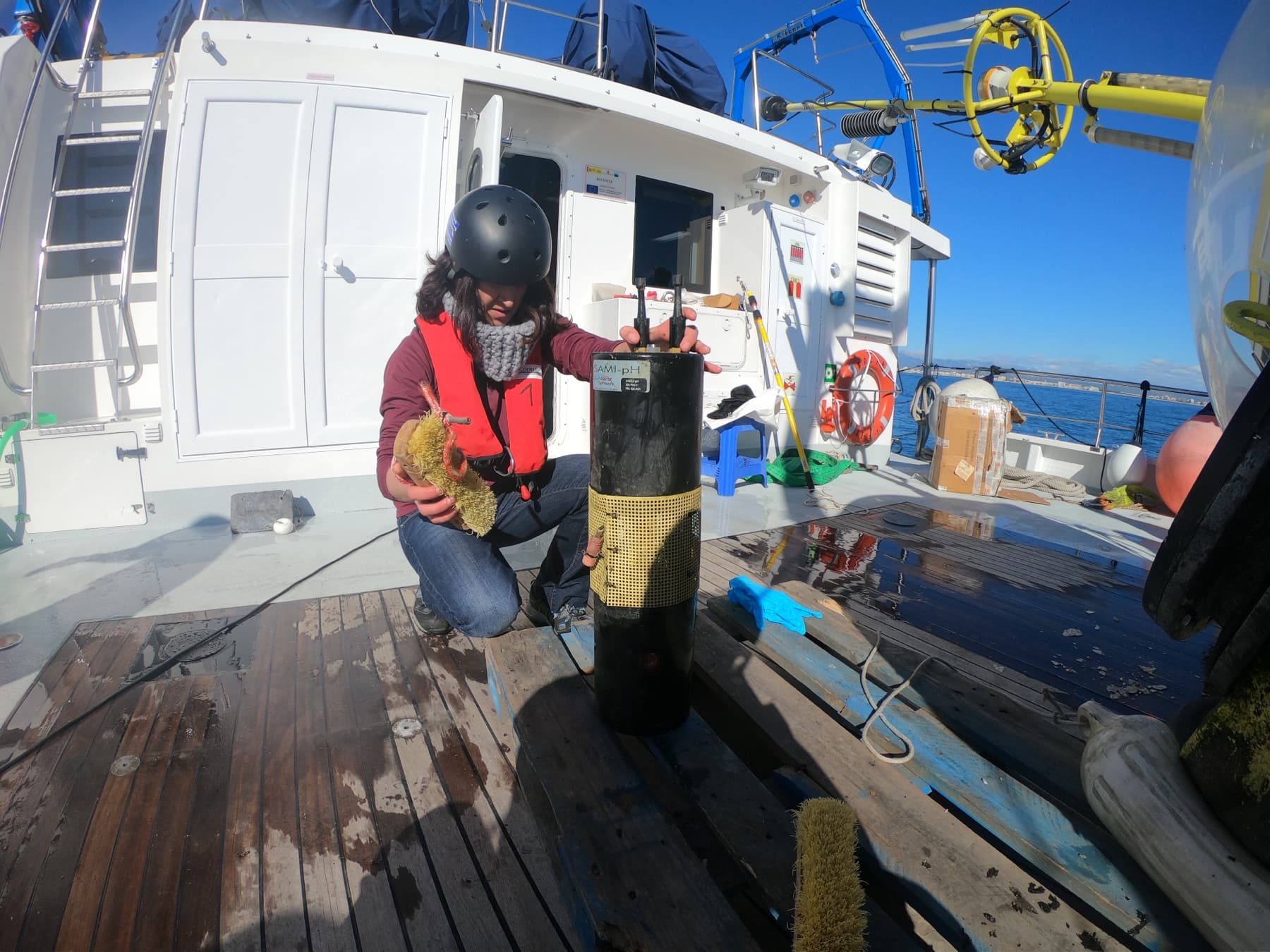
Acquisition of Autonomous pH Sensors (SAMI)
Acquisition and deployment of autonomous SAMI pH sensors for continuous monitoring of ocean acidification in Mediterranean coastal waters.
- Funding
- Gobierno de las Islas Baleares
- Budget
- € 19,560
03 /
Observational infrastructures
GIFT
Since 2008Gibraltar Fixed Time Series
Strait of Gibraltar · 35.92°N 5.75°W
Long-term oceanographic series based on high-frequency sampling of biogeochemical and physical variables in the Strait of Gibraltar, monitoring the exchange of water masses between the Atlantic and the Mediterranean.
Role · Scientific coordinator
- Carbon system and biogeochemical parameters
- Quantification of decadal acidification rates in Atlantic and Mediterranean water masses
- Results integrated into the IPCC SROCC (2019) and the CLIVAR-Spain 2025 report
- Data deposited in IOC-UNESCO and DIGITAL.CSIC open repositories
BOATS
Since 2018Balearic Ocean Acidification Time Series
Balearic Sea · 39.49°N 2.62°E
Coastal observation network in the Balearic Sea, with emphasis on Posidonia oceanica meadows, providing high-frequency pH and biogeochemical monitoring for ocean acidification assessment in Mediterranean coastal waters.
Role · Co-founder and co-Principal Investigator
- AI-based methodologies for continuous pH reconstruction
- Characterisation of acidification trends, water-column oxygenation and GHG emissions
- Methodologies transferred to deep-sea ecosystems through EVALUARTE and INDICLIMA
COJOHNS
Since 2024Carbon Observatory Johnson
Livingston Island, Antarctica · 62.66°S 60.37°W
High-frequency time series of seawater pH, pCO₂ and additional environmental variables (temperature, salinity, dissolved oxygen, chlorophyll) in Johnsons Cove (Caleta Johnson), Livingston Island (South Shetland Islands, Antarctica) — a glacier-influenced embayment adjacent to a tidewater glacier on the western Antarctic Peninsula.
Role · Scientific coordinator
- Continuous pH and pCO₂ monitoring via a fixed mooring with autonomous sensors (active since February 2024)
- First year-round record of carbonate-system variability in a glacier-fed Antarctic embayment
- Quantification of air–sea CO₂ fluxes to assess the area as a sink or source of CO₂ to the atmosphere
- Strengthens the observational framework for coastal carbon inputs to the Southern Ocean and improves the representation of Antarctic waters in global C-cycle assessments
04 /
Open-source tools
GIFT Dashboard
Open-source platform for managing, visualising and analysing the GIFT biogeochemical time series. Developed as lead author and aligned with the FAIR principles.
CO₂ Prediction · BiLSTM
Deep-learning model that integrates oceanographic, meteorological and seismic data to estimate seawater CO₂ at Deception Island (Antarctica). A novel methodological development identifying the influence of volcanic seismicity on CO₂ dynamics, fully reproducible through open data and open models (published in Scientific Data, 2025).
05 /
Selected team-member projects
Blue Health
2026 – 2028
ICMAN-CSIC Excellence Plan · MAX-CSIC 2024 (DEEPMAX-2024-2)
Institutional excellence strategy Blue Health: a One Health approach for the ocean. Co-leading the Scientific Leadership & Cross-cutting plan: consolidation of the DATALAB cross-cutting technical unit, a three-level training programme in AI and data science applied to marine sciences, intergenerational mentoring, interdisciplinary co-supervision, and positioning of ICMAN-CSIC in international networks under the One Ocean, One Health identity.
- Funding
- MAX-CSIC 2024 + ICMAN-CSIC resources
- Budget
- € 657,400 (Objective 8: € 62,900)
- Role
- Co-coordinator of Objective 8 — “Scientific Leadership & Technological Cross-cutting”
AMIGA
2026
Antarctic Methane and Ice-Marine GHG Assessment
Transnational access to the Neumayer Station III research infrastructure (Alfred Wegener Institute, Antarctica), coordinated by the Thule Institute, University of Oulu (Finland). Responsible for the biogeochemical components in Antarctic coastal waters adjacent to Neumayer III, integrating in-situ observations with advanced data-analysis methods.
- Funding
- EU HORIZON — POLARIN Transnational Access (GA 10113094)
- Budget
- € 102,000
- Role
- Participating researcher — biogeochemistry (CH₄, N₂O and carbon system)
BIMAR2025 · GIFT4ALL
2026 – 2028
Gibraltar Fixed Time Series for AI Operational Tools
- Funding
- CSIC — BIMAR2025
- Budget
- € 17,605.34
- Role
- Work-package leader for Artificial Intelligence
DICHOSO
2023 – 2026
Deception Island Biogeochemical Inventories in the Southern Ocean
- Funding
- Ministerio de Ciencia e Innovación
- Budget
- € 338,800
- Role
- Work-package leader for Greenhouse Gases
CYCLE
2022 – 2026
Complex Dynamics of Coastal Ecosystems and Climate Resilience
- Funding
- MCIN
- Budget
- € 258,940
- Role
- BOATS network station coordinator
COOPB22023
2023 – 2024
GHG Dynamics on the Southern Coasts of the Mediterranean
- Funding
- CSIC
- Budget
- € 21,976
- Role
- Scientific coordinator
SuMaEco
2019 – 2022
Sustainability of Coastal Mediterranean Marine Ecosystems
- Funding
- MCIN
- Budget
- € 239,580
- Role
- BOATS network station coordinator
Posi-COIN
2019 – 2021
Ecosystem Services & Carbon Sinks of Posidonia oceanica
- Funding
- Fundación BBVA
- Budget
- € 99,830
- Role
- Scientific coordinator
ANTROPOSI
2018 – 2019
Human Pressures on Posidonia in the Anthropocene
- Funding
- Save Posidonia Project
- Budget
- € 83,821.54
PERMEAD
2015 – 2018
Biogeochemistry of Doñana Wetlands
- Funding
- Autonomous Agency for National Parks
- Budget
- € 57,312.55
06 /
International projects & programmes
PERSEUS
Policy-oriented marine Environmental Research in the Southern European Seas
FP7-OCEAN-2011 · 2012–2016
CARBOCHANGE
Change in Carbon Uptake and Emissions by Oceans in a Changing Climate
FP7, Ref. 264879 · 2011–2015
SESAME
Southern European Seas: Assessing and Modelling Ecosystem Changes
FP6-036949 GOCE · 2006–2011
CARBOOCEAN
Marine Carbon Sources and Sinks Assessment
FP6-511176 GOCE · 2005–2009
COST Action 735
Tools for Assessing Air–Sea Fluxes of Climate Gases
Short-Term Scientific Mission, Université de Liège (2010)
AMIGA
Antarctic Methane and Ice-Marine GHG Assessment
EU HORIZON — POLARIN Transnational Access (GA 10113094), Neumayer Station III · 2026
Canon Foundation
Canon Foundation in Europe Research Fellowship
JAMSTEC (Japan), 2016–2017
Pier2Peer
Pier2Peer Mentorship Programme
NOAA Ocean Acidification Program, 2025–2026
07 /
Oceanographic expeditions
I have participated in 50 oceanographic cruises (≈ 287 days at sea) across a wide range of regions.
Atlantic & Iberian Margin
- GIFT campaigns — Strait of Gibraltar permanent stations (2008 – present)
- P3A2 — Gulf of Cádiz (2008)
- Patagonia Fjord — San Ignacio de Huinay, Chile (2013)
Mediterranean Sea
- CANALES — Ibiza and Mallorca Channel (2022 – 2025)
- BOATS — Balearic Islands (2018 – present)
- Mediterranean CARIMED synthesis campaigns
Polar Regions
- DICHOSO — Antarctic Peninsula (2024 – 2025)
- POLAROMICS — Antarctic Peninsula (2026)
- Deception Island — volcanic CO₂ dynamics
Northern Europe
- Regional Training course onboard R/V Professor Shtokman — Baltic Sea (2007)
08 /
Scientific equipment
- Continuous CO₂ measurement systems (LICOR, Contros HydroC)
- Autonomous pH sensors (SAMI, SeaFET)
- Oxygen, temperature, salinity and fluorescence optodes
- CTD rosettes and oceanographic moorings
- Laboratory instrumentation for carbon-system analysis (DIC/TA coulometry, spectrophotometry, gas chromatography)
Transfer & applications
- International climate assessments
- IPCC SROCC (2019), CLIVAR-Spain 2025
- Monitoring protocols
- OOI Biogeochemical Sensor Data Best Practices and User Guide
- Open-access public databases
- IOC-UNESCO SDG 14.3.1, DIGITAL.CSIC, SOCAT v2026, GLODAP
- Regional policy support
- Andalusian Regional Government, Gobierno de las Islas Baleares